This article appeared in Knife Magazine in April 2026.
Know Your Knife Laws – What is a Gravity Knife?
By Anthony Sculimbrene, Attorney and Knife Expert
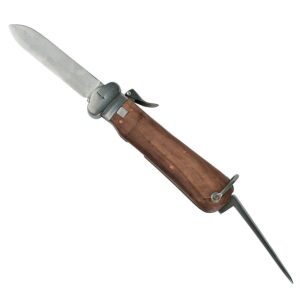
Thanks to legislative changes and judicial opinions, folks have more carry options now than ever before. But a lot of these changes focus on the design of the knife. The Federal Switchblade Act (FSA) and many state statutes impact automatic knives, but they also impact other knife designs as well. One design that is almost as universally banned as autos is gravity knives. But the definition of a gravity knife is much vaguer than that of an automatic knife. And even with the wave of changes to state laws regarding simple possession of autos and gravity knives, many states have arbitrary rules prohibiting carry, like New Jersey law §2C:39-5, which bans the carry of autos or gravity knives when used for “manifestly” improper purposes. Many states ban concealed carry, but the definition of concealed carry is still not terribly precise. With those caveats, it’s probably helpful to figure out what counts as a gravity knife.
Most statutes list gravity knives in the group of “usual suspect” edge weapons and do not specifically define them. A handful of laws actually get into the details. Let’s start with the FSA. The FSA defines a gravity knife as a knife that “opens automatically…by operation of inertia, gravity, or both. “See 15 USC §1241(b)(2). That’s not particularly helpful. Other statutes are more explicit. California, which also lumps gravity knives with autos, defines a gravity knife as a knife with a blade “…which can be released automatically by a flick of a button, pressure on the handle, flip of the wrist, or other mechanical device, or is released by the weight of the blade…” See California Penal Code §17235. New Jersey has a broader definition, which is, importantly, separate from its definition of an automatic knife: “…’[g]ravity knife’ means any knife which has a blade which is released from the handle or sheath thereof by the force of gravity or the application of centrifugal force.” See New Jersey, NJS §2C:39-1(h). New York’s definition is the same. See NYPL §265.01. West Virginia defines a gravity knife as “any knife that has a blade released from the handle by the force of gravity for the application of centrifugal force and when released is locked in place by means of a button, spring, lever, or other locking or catching device. See WVa Code §61-7-2. Alaska also has a definition of gravity knife: “any knife that has a blade that opens or releases a blade from its handle or sheath by the force of gravity or by application of centrifugal force…” See Alaska Statute §11.81.900. That, unfortunately, is the sum total of current statutes in the U.S. that define gravity knives. But it leaves many questions unanswered.
Another place to turn is history. The oldest patent I could find for a gravity knife was from 1884, well before what most people think of as the first gravity knife, the German parachute knife (the Flieger Kappmesser) from 1937. The 1884 patent (No. 307,767; patentee: Isaac Heysinger) describes a knife where the blade is held in the handle by a catch. Once the catch is removed and the handle is pointed down, the blade slides out. When the catch is released after the knife slides out, the blade is locked in the open position. The knife can be closed by releasing the catch again and pointing the handle up. Both the 1884 knife and the German knife were designed to be deployed one-handed. They needed to be absolutely fail-safe because they were used to cut away tangled cordage during parachute jumps. Springs can break, and slides can jam, but gravity always works. The common feature among the 1884 knife, the German knife, and the majority of modern designs, like the Reate EXO, is that they are out-the-front designs. Virtually all gravity knives work by sending the blade out the front of the handle. Given the language and history, these designs are easy to see as falling into the category of prohibited knives.
Other recent designs, however, are complicated. Many knives that use button locks have smooth pivots with washers or bearings. Releasing the button and moving the knife pops the blade out of the side of the handle. Are these gravity knives? This is where the actual language used in the statute matters. What about designs like the Civivi Elementum C2103C, which has no other method of deployment other than pressing the button for the lock and swinging the blade open?
In these cases, I think whether they are considered gravity knives depends on the jurisdiction. The FSA requires gravity knives to “open automatically.” Basically, you do X and the knife opens. Other jurisdictions, such as Alaska, New Jersey, and New York, omit the “automatic” language and instead focus on whether the blade deploys by gravity or centrifugal force. In these places, the two-step process doesn’t seem to save the design. Automatic or not, one-step or two-step, these “out-the-side gravity knives” all deploy via gravity-driven centrifugal motion. Knives with a detent might fare differently. If you have to push a button AND overcome a detent, that might save the design, but knives that swing freely IMMEDIATELY after pressing a button arguably count as gravity knives in various places.
As the law changes, proponents of the Second Amendment need to be thorough in cleaning up bad statutes. Leaving threads hanging, like what counts as a gravity knife, could have unintended and bad consequences.
Learn more about knife laws and how they could impact you at www.AKTI.org. The American Knife & Tool Institute strives to provide knife owners with reliable, accurate law information and advocates for responsible and reasonable changes that benefit the knife community.